



Building a Strong Foundation in Maths for Future Success
Strong maths skills are about more than just high marks in school; they are a fundamental tool for life. We see this every day in India, whether it’s a child carefully managing their pocket money to buy a comic book or calculating discounts during a bustling Diwali sale. Yet, many children and even parents experience a ‘maths phobia’, a feeling of anxiety around numbers. The first step to overcoming this is a parent’s encouraging attitude. Your belief in your child’s ability to learn is the most powerful tool you have.
Mathematical ability forms the bedrock for logical reasoning and problem-solving. These are the very skills that open doors to aspirational careers in India’s thriving tech hubs like Bengaluru and Hyderabad. By nurturing these skills, you are preparing your child for a bright future. This isn’t about pressuring them to become a prodigy. Instead, the goal is to cultivate a curious and confident mindset towards numbers. These simple maths tips for parents are designed to help you build that foundation, one small step at a time.
The Power of the Abacus for Mental Agility
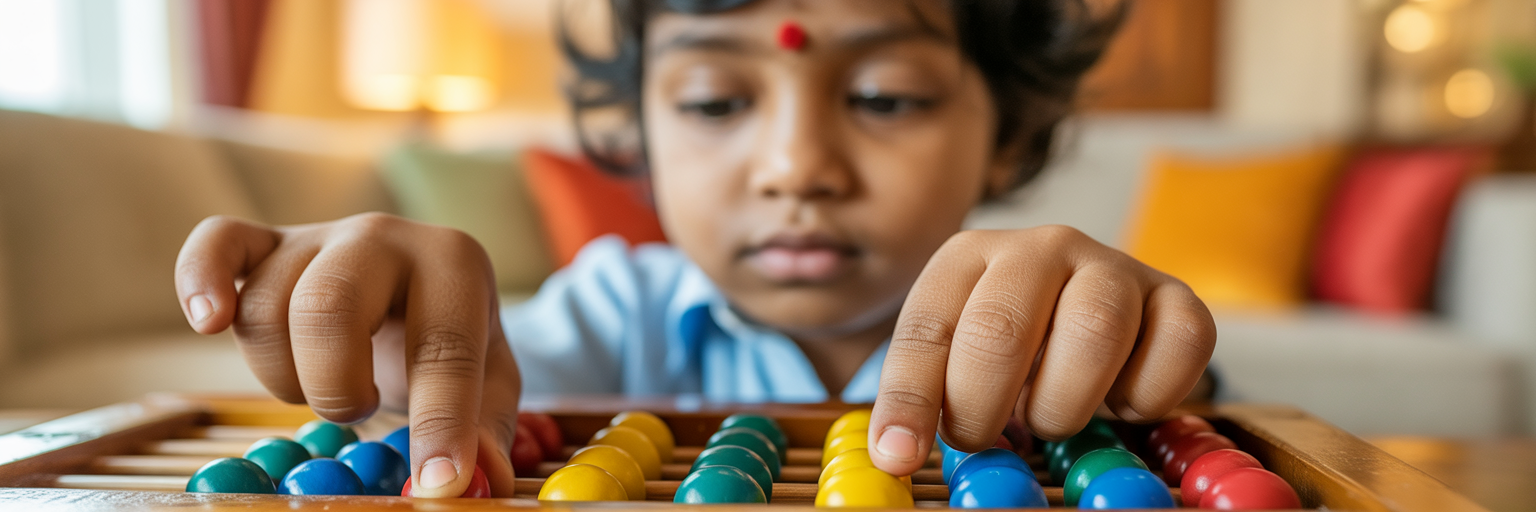
One of the most effective tools for building this foundation is the abacus, a time-honoured instrument that sharpens mental maths abilities. Its benefits extend far beyond simple calculation. The abacus teaches children to visualise numbers, a process that significantly enhances concentration and memory. The physical act of moving the beads improves fine motor skills and stimulates both the left and right hemispheres of the brain, promoting balanced cognitive growth.
This method is fundamentally different from rote memorisation. While memorising tables can be useful, the abacus builds a deeper understanding of how numbers work, leading to superior speed and accuracy. A child first learns to use the physical tool, but with practice, they begin to picture the abacus in their mind, performing complex calculations mentally. This is particularly effective for children aged 4 to 14, whose brains are developing rapidly. Structured abacus classes for children provide the expert guidance needed to master this skill, contributing directly to a child’s overall child cognitive development.
| Factor | Rote Memorisation (Tables) | Abacus Learning |
|---|---|---|
| Speed | Slow for complex problems | Significantly faster calculations |
| Accuracy | Prone to errors under pressure | High degree of accuracy |
| Concentration | Requires minimal focus | Builds deep concentration |
| Visualisation | Not developed | Core skill developed (mental abacus) |
| Understanding | Focuses on ‘what’ (the answer) | Focuses on ‘how’ (the process) |
Making Maths Fun with Everyday Games
Beyond structured tools, turning maths into an enjoyable activity is one of the best ways to reduce anxiety and build confidence. Learning through play allows children to engage with numbers in a low-pressure environment. As highlighted in a guide by Prodigy, incorporating fun activities at home is a proven way to reinforce maths skills without the stress of formal lessons. There are many fun maths activities for kids that you can easily introduce into your family time.
- Classic Board Games: Games like Ludo and Snakes and Ladders are perfect for practicing counting and basic addition. Keeping score during a game of Carrom is another great way to practice addition in a competitive, fun setting.
- Card Games: Simple card games like Uno help younger children with number and colour recognition. For older kids, a basic version of Rummy can teach valuable skills like sequencing, sorting, and grouping numbers.
- Mindful Digital Games: Not all screen time is equal. Choose quality educational apps that focus on logic puzzles and strategic thinking rather than just repetitive drills. These games can build problem-solving skills in an engaging format.
- Create Your Own Games: Get creative during daily routines. Challenge your child to count the number of scooters versus cars on the road during a drive. Or, set up a pretend shop with household items and play money to practice buying, selling, and making change.
Finding Maths in Daily Life

Building on the idea of playful learning, you can find countless opportunities to show your child how to improve maths for kids by integrating it into daily routines. This makes numbers practical and relevant. This hands-on approach is supported by child development experts. For instance, guidance from organisations like the CDC, as detailed in resources from Children’s Wisconsin, notes that using physical objects to count and compare helps children grasp concepts more easily.
In the Kitchen
The kitchen is a fantastic laboratory for maths. Involve your child in measuring ingredients like rice or dal in cups. Ask them to count out vegetables or help you double a recipe when guests are coming over. These simple tasks teach fractions, measurement, and multiplication in a tangible way.
During Shopping Trips
Turn a trip to the local market into a maths lesson. Give an older child a small budget and a short list of items. Let them calculate the total cost and work out the change they should receive. This teaches budgeting, addition, and subtraction with real-world consequences.
With Time and Sports
Time and sports are filled with numbers. Discuss time by asking practical questions: “If the train is at 5:00 PM and it takes 45 minutes to get to the station, when should we leave?” For sports fans, use the national passion for cricket to explain concepts like run rates, player averages, and strike rates, making numbers exciting and relatable.
Nurturing a Positive and Confident Mindset
How you talk about maths at home has a huge impact on your child’s confidence. Building a positive environment is just as important as practicing calculations. It’s about fostering a “growth mindset,” where your child understands that abilities can be developed through dedication and hard work.
- Praise the Process: Instead of only celebrating the right answer, praise your child’s effort in tackling a tough problem. Say things like, “I love how you kept trying even when it was difficult.” This teaches persistence.
- Stay Positive: Be mindful of your own words. Avoid saying things like, “I was never good at maths.” Your calm and encouraging tone is crucial, as children can easily absorb your stress.
- Talk to the Teacher: In India, the parent-teacher partnership is highly valued. Regularly communicate with your child’s teacher to understand their progress and identify areas that may need extra support at home.
- Create a Study Zone: A quiet, well-lit space free from distractions like the TV or loud conversations can make a big difference. This dedicated corner signals that learning is a family priority and helps your child focus.
Developing Holistic Skills Beyond Calculations
Ultimately, the goal is to raise a well-rounded, confident individual. While strong maths skills are vital, they are most powerful when paired with other cognitive abilities. Activities that improve logical thinking are excellent companions to maths practice. Chess, a game with deep roots in India, is a prime example. It teaches strategy, foresight, and the ability to think several steps ahead.
Even skills like neat handwriting and drawing contribute to mathematical thinking. They require precision, attention to detail, and spatial awareness—abilities that help in structuring and solving complex problems. A strong command of maths is a critical component of your child’s education, but it shines brightest when combined with creativity, critical thinking, and a genuine love for learning.